Home » Without Label » 38+ inspirierend Bilder Distribution Of Matter In The Universe - AMAZING STORIES: Unusual Dark Matter in NASA's Amazing 3D Map / Researchers must instead infer its distribution based on its gravitational influence on other objects in the universe, like galaxies.
38+ inspirierend Bilder Distribution Of Matter In The Universe - AMAZING STORIES: Unusual Dark Matter in NASA's Amazing 3D Map / Researchers must instead infer its distribution based on its gravitational influence on other objects in the universe, like galaxies.
38+ inspirierend Bilder Distribution Of Matter In The Universe - AMAZING STORIES: Unusual Dark Matter in NASA's Amazing 3D Map / Researchers must instead infer its distribution based on its gravitational influence on other objects in the universe, like galaxies.. It must be in the form of some intergalactic medium, and there must be sufficient of it to prevent the member galaxies from escaping. One of the main researchers, said donghui jeong, an astrophysicist at pennsylvania state university in the united states. The distribution of matter is highly uneven in the local universe. This network of structure is called the 'cosmic web'. Even so, the velocities of galaxies inside a cluster are much greater than the velocities of stars inside a.
Scientists have shown that the dark matter in galaxies follows a 'maximum entropy' distribution, which sheds light on its nature. On the distribution of matter and energy in the universe. However, the findings seem to contradict einstein's theory of relativity. The results are a surprise because they show that it. The mass that can't be seen is called dark matter.
Map of Matter in the Universe | NASA from www.nasa.gov Dark matter appears to be concentrated in and around galaxies and in clusters on scales of tens to thousands of kpc, and probably forms even larger filamentary structures which lead to the large scale structure we see on very big scales (tens of mpc). Researchers mapped the distribution of dark matter in the universe for the first time. On very large scales, matter in the universe is arranged in a wispy network consisting of huge clusters of galaxies, linked to one another by dense filaments of gas and invisible dark matter and interspersed with gigantic cosmic voids: The dispersion of radio waves as they travel through the intervening. Even so, the velocities of galaxies inside a cluster are much greater than the velocities of stars inside a. How is matter distributed in the universe? Astronomers like to call all material made up of protons, neutrons and electrons baryonic matter. Scientists have shown that the dark matter in galaxies follows a 'maximum entropy' distribution, which sheds light on its nature.
Which can be recast as the equation of motion of mass m on the surface of an expanding spherical distribution of matter m and radius r ≡ a.
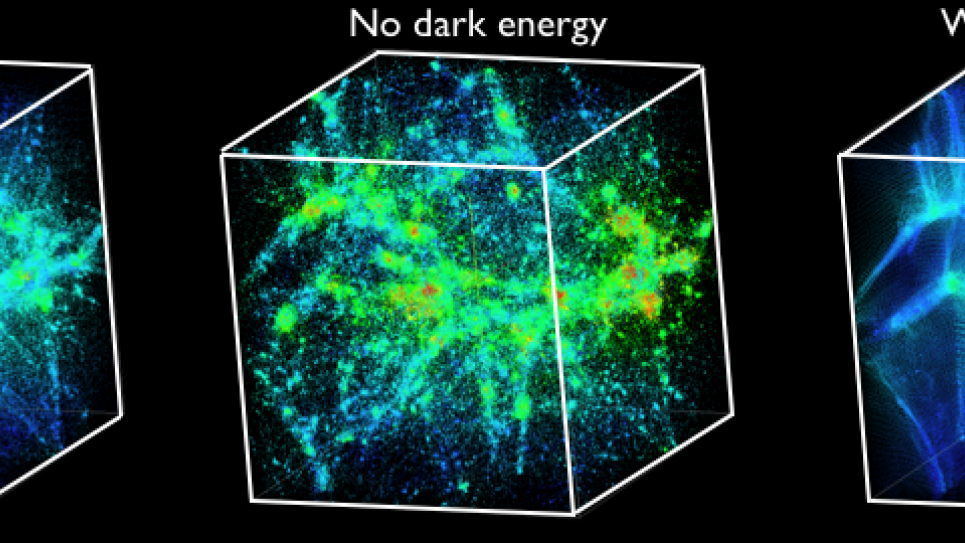
The first is simply observing the position and distribution of galaxies across the universe. Scientists have shown that the dark matter in galaxies follows a 'maximum entropy' distribution, which sheds light on its nature. Helium is composed of two protons, two neutrons and two electrons. It was constructed by measuring the shapes of half a million galaxies observed by hubble. (2) we frequently observe matter between the galaxies. One of the main researchers, said donghui jeong, an astrophysicist at pennsylvania state university in the united states. + universe with the measured amount of radiation, and then either 70% dark energy, 25% dark matter, and 5% normal matter (l), or a universe with 100% normal matter and no dark matter (r). Researchers mapped the distribution of dark matter in the universe for the first time. The following considerations represent an attempt to analyze those effects which govern the large scale distribution of matter in the universe. Neu theory uses this volume, as a starting value in its calculations, meaning one (1) neu number is initially attributed 4.0 cubic meters of space (zome). Astrophysicists nowadays think that in the early stages of the development of the universe there was no such inhomogeneity. This distribution represents a clue that indicates for scientists where the greatest concentrations of dark matter are. The following considerations represent an attempt to analyze those effects which govern the large scale distribution of matter in the universe.
In some cases the galaxies require even more time to cross the cluster once, a good fraction of the age of the universe. It is proposed to discuss On very large scales, matter in the universe is arranged in a wispy network consisting of huge clusters of galaxies, linked to one another by dense filaments of gas and invisible dark matter and interspersed with gigantic cosmic voids: It is the planets, galaxies, gas clouds, and clusters. How is matter distributed in the universe?
Missing Galaxies Explained by Dark Matter Interactions in ... from d.ibtimes.co.uk Nasa has published on their website, that based on astronomical observations, the average distribution of matter in the universe is one atom per four cubic meters of space. However, the distribution of local dark matter is currently unknown because it cannot be measured directly. It is the planets, galaxies, gas clouds, and clusters. Helium is composed of two protons, two neutrons and two electrons. The other component is to monitor the gravitational lensing effect. The results are a surprise because they show that it. + universe with the measured amount of radiation, and then either 70% dark energy, 25% dark matter, and 5% normal matter (l), or a universe with 100% normal matter and no dark matter (r). How is matter distributed in the universe?
There are two basic elements to building a map.
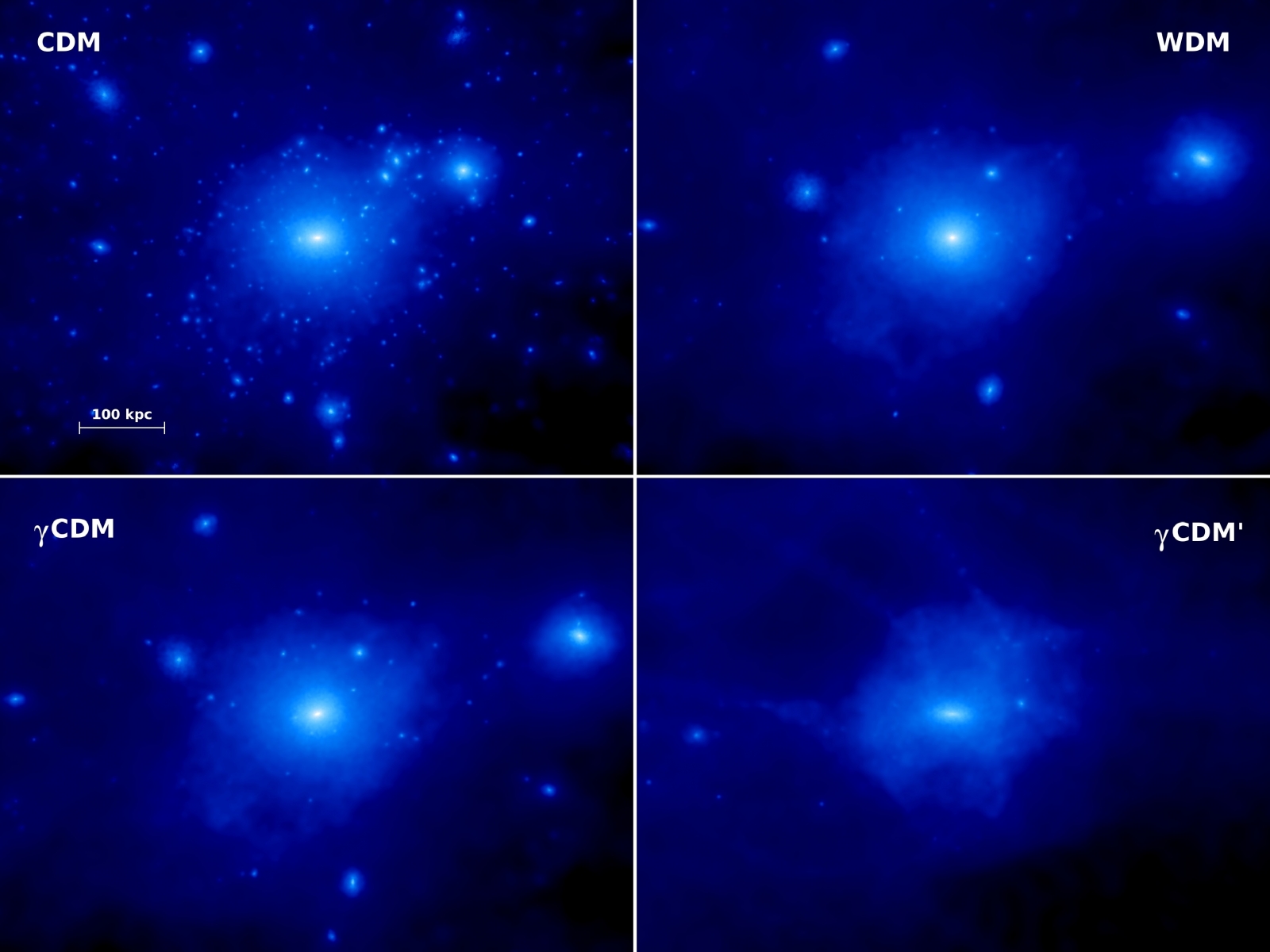
Which can be recast as the equation of motion of mass m on the surface of an expanding spherical distribution of matter m and radius r ≡ a. The topics spanned issues as the distribution of galaxy morphologies, the distribution of galaxies in the compact groups, the distribution of luminous (substructures) and dark matter in clusters of galaxies, and the distribution of dark matter in the local universe, going far beyond the nearest clusters of galaxies. (1) the velocity curves of galaxies show that galaxies are surrounded by massive halos. It must be in the form of some intergalactic medium, and there must be sufficient of it to prevent the member galaxies from escaping. Neu theory uses this volume, as a starting value in its calculations, meaning one (1) neu number is initially attributed 4.0 cubic meters of space (zome). Dark matter distribution in the universe is different than predicted researchers at yale university found that smaller clumps of dark matter are significantly more concentrated than previously thought. It is proposed to discuss the problems of: Researchers mapped the distribution of dark matter in the universe for the first time. There are two basic elements to building a map. Researchers must instead infer its distribution based on its gravitational influence on other objects in the universe, like galaxies. Large concentrations of matter, such as stars and planets, are interspersed with large areas of empty space. A glance through our cosmic neck of the woods reveals that matter in the universe is distributed in a highly structured fashion. In some cases the galaxies require even more time to cross the cluster once, a good fraction of the age of the universe.
However, the distribution of local dark matter is currently unknown because it cannot be measured directly. Nasa has published on their website, that based on astronomical observations, the average distribution of matter in the universe is one atom per four cubic meters of space. The member galaxies have velocities of the order of 1000 km/sec and require a billion years to cross them. + universe with the measured amount of radiation, and then either 70% dark energy, 25% dark matter, and 5% normal matter (l), or a universe with 100% normal matter and no dark matter (r). At the present time the distribution of matter in the universe is highly inhomogeneous (there are planets, the sun, stars, galaxies, clusters of galaxies and so on).
Exploring the Nature of the Lightest Massive Particles in ... from www.alcf.anl.gov Researchers mapped the distribution of dark matter in the universe for the first time. One of the main researchers, said donghui jeong, an astrophysicist at pennsylvania state university in the united states. (a) the frequency of occurrence of clusters of nebulae which contain different numbers of nebulae, (b) the relative numbers of nebulae in dependence of their intrinsic luminosity and mass, and (c) the. Neu theory uses this volume, as a starting value in its calculations, meaning one (1) neu number is initially attributed 4.0 cubic meters of space (zome). Even so, the velocities of galaxies inside a cluster are much greater than the velocities of stars inside a. It is proposed to discuss However, the distribution of local dark matter is currently unknown because it cannot be measured directly. Which can be recast as the equation of motion of mass m on the surface of an expanding spherical distribution of matter m and radius r ≡ a.
The member galaxies have velocities of the order of 1000 km/sec and require a billion years to cross them.
Heavier elements, such as iron, lead and uranium, contain even larger numbers of protons, neutrons and electrons. In some cases the galaxies require even more time to cross the cluster once, a good fraction of the age of the universe. Nasa has published on their website, that based on astronomical observations, the average distribution of matter in the universe is one atom per four cubic meters of space. Astronomers like to call all material made up of protons, neutrons and electrons baryonic matter. One of the main researchers, said donghui jeong, an astrophysicist at pennsylvania state university in the united states. How is matter distributed in the universe? Dark matter distribution in the universe is different than predicted researchers at yale university found that smaller clumps of dark matter are significantly more concentrated than previously thought. The first is simply observing the position and distribution of galaxies across the universe. There are two basic elements to building a map. It was constructed by measuring the shapes of half a million galaxies observed by hubble. It is the planets, galaxies, gas clouds, and clusters. (1) the velocity curves of galaxies show that galaxies are surrounded by massive halos. (2) we frequently observe matter between the galaxies.